
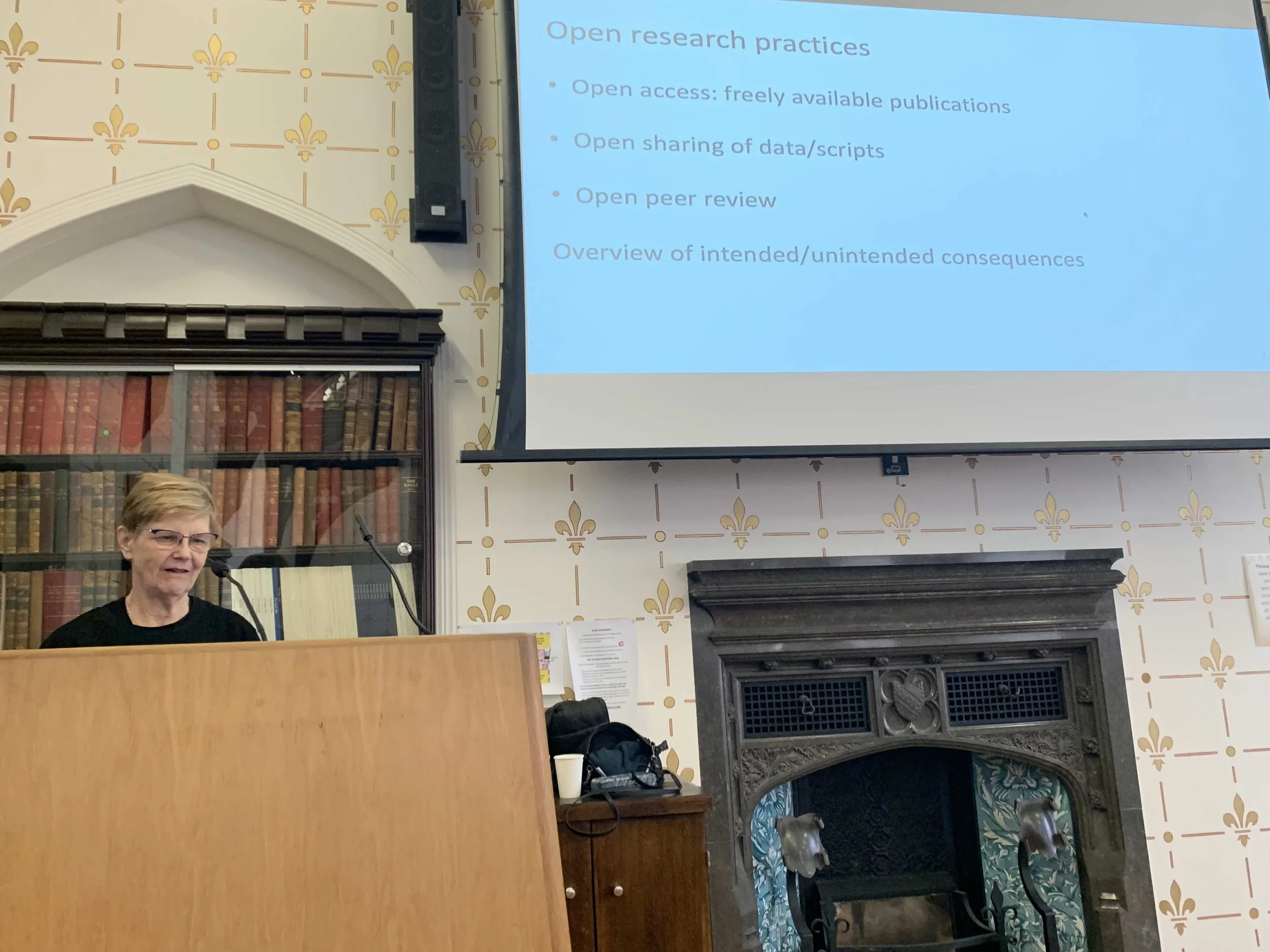
Pictured here is Professor Dorothy Bishop giving her talk.
Benevolent and Malevolent Unintended Consequences of Open Science
22 May 2026
On 27 March 2026, the RRCam community had the privilege of hearing from Dorothy Bishop, Emeritus Professor at the University of Oxford and a leading advocate for research integrity, reproducibility, and open science.
Professor Bishop’s lecture titled “Benevolent and Malevolent Unintended Consequences of Open Science” explored both the benefits and the unintended risks associated with open science practices. She highlighted that the core principles of open science: open access, open sharing of data/scripts, open peer review, are fundamentally aimed at improving the quality and trustworthiness of research. Referencing comments by Sir Mark Walport, she noted the importance of ensuring that publicly funded science is accessible to the public.
However, the presentation also emphasised that some of the current problems lie not with open science itself, but with the publishing ecosystem surrounding it. Open access publishing fees continue to rise, creating increasing revenues for publishers while shifting costs onto researchers and institutions.
A particularly striking aspect of the lecture focused on how open science can help expose research misconduct and fraud. Professor Bishop described examples where open datasets and transparent peer review enabled researchers to identify fabricated or inconsistent data that would otherwise have gone unnoticed. She also discussed the growing problem of paper mills, fraudulent peer review practices, and the misuse of openly available datasets.
Transparency remains one of the strongest tools available for protecting research integrity. Open peer review, study pre-registration, post-publication discussion platforms such as PubPeer, and access to data and code all make it easier to scrutinise findings, detect problems, and improve the robustness of scientific research.
Professor Bishop concluded with an important reflection: whenever systems change, people may attempt to “game” them for their own benefit, with publications and citations becoming a fungible commodity. Some bad practices will only change when academia changes what it values. Nevertheless, open science provides powerful mechanisms for identifying misconduct and improving accountability across the research ecosystem.