
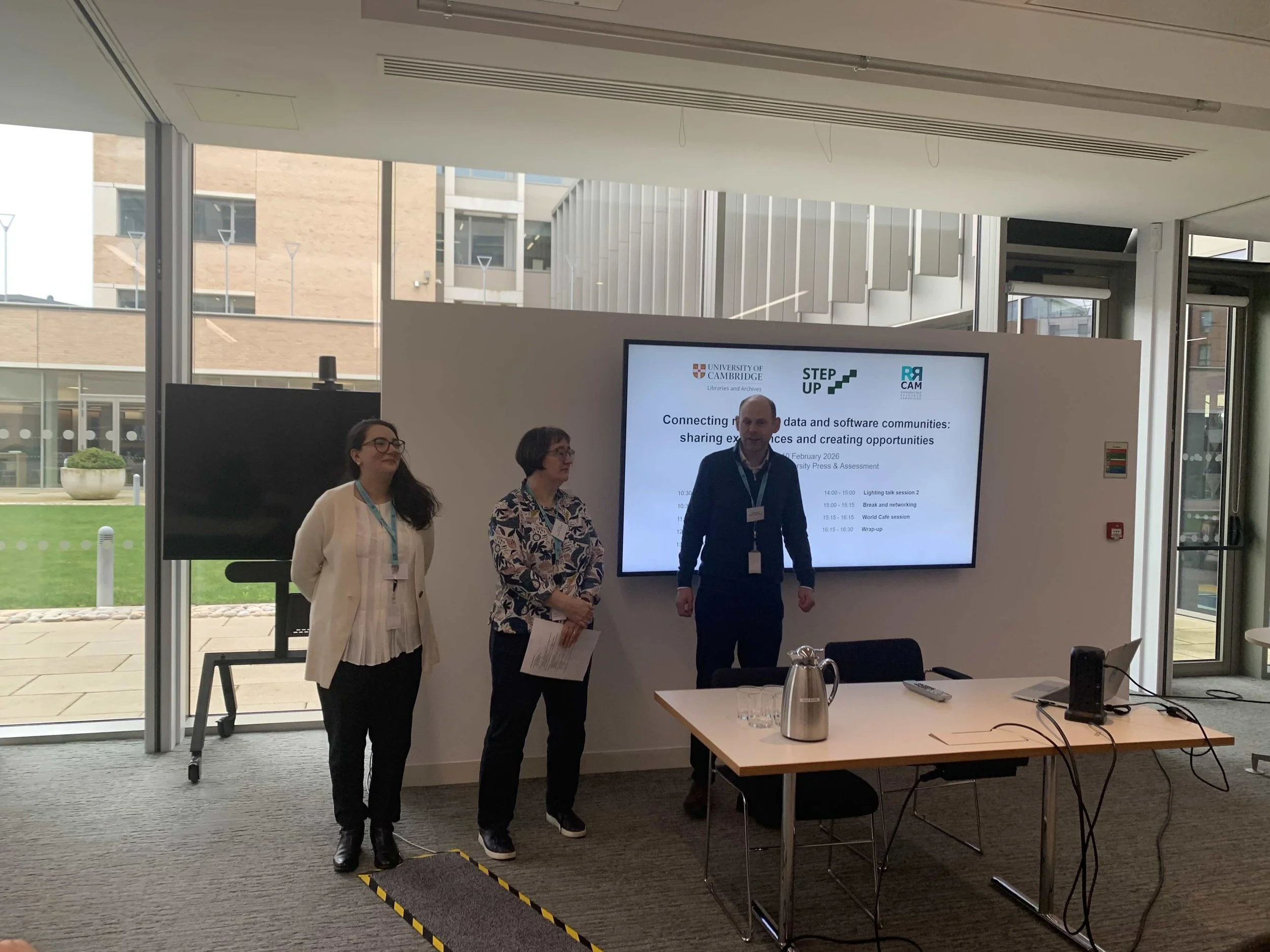
Pictured here are Dr Alexia Cardona, Dr Gina Moghaddam and Dr Martin O’Reilly introducing the Love Data Week event.
Connecting Research Data and Software Communities
22 May 2026
On 10 February 2026, during Love Data Week, STEP-UP, the University of Cambridge Research Data Team and Reproducible Research Cambridge brought together 38 participants from across the UK and Europe to explore how research data and research software practices intersect within digital research.
As recognition grows of the increasingly vital role played by digital Research Technical Professionals (dRTPs), the event created space for dialogue between Research Software Engineers, Data Stewards and Champions, researchers, and others working at the interface of software and data. The programme kicked off with two keynote speakers:
Dr Martin O’Reilly, Director of Research Engineering at the Alan Turing Institute, traced the development of Research Software Engineering and reflected on ongoing technical and professional challenges, including recognition, sustainability and career progression;
Dr Gita Moghaddam, Principal Investigator in the Department of Clinical Neurosciences at the University of Cambridge, examined what it means to build “decision-ready” systems based on data. She emphasised that robustness is not just about model performance, but also about transparency, representativeness, operational reliability and predefined responses to failure. A central message emerged: data and software must be treated as a unified system rather than as separate technical domains.
There was a variety of lightning talks showcasing practical efforts to improve research workflows, from tools that verify published code and create reproducible computational environments, to federated data movement between organisations, curated computational model platforms, in-house infrastructure development, community-building initiatives within dRTP teams, and emerging certification schemes for green computing.
Despite the diversity of projects, common themes surfaced: many initiatives attempt to solve long-standing systemic issues without long-term funding; technical labour often remains invisible; and institutional infrastructures, policies and technology stacks vary widely.
The World Café discussions deepened these reflections across themes of training, careers, infrastructure, AI, sustainability, publishing and commercialisation. RRCam was represented at the event by Dr Alexia Cardona.